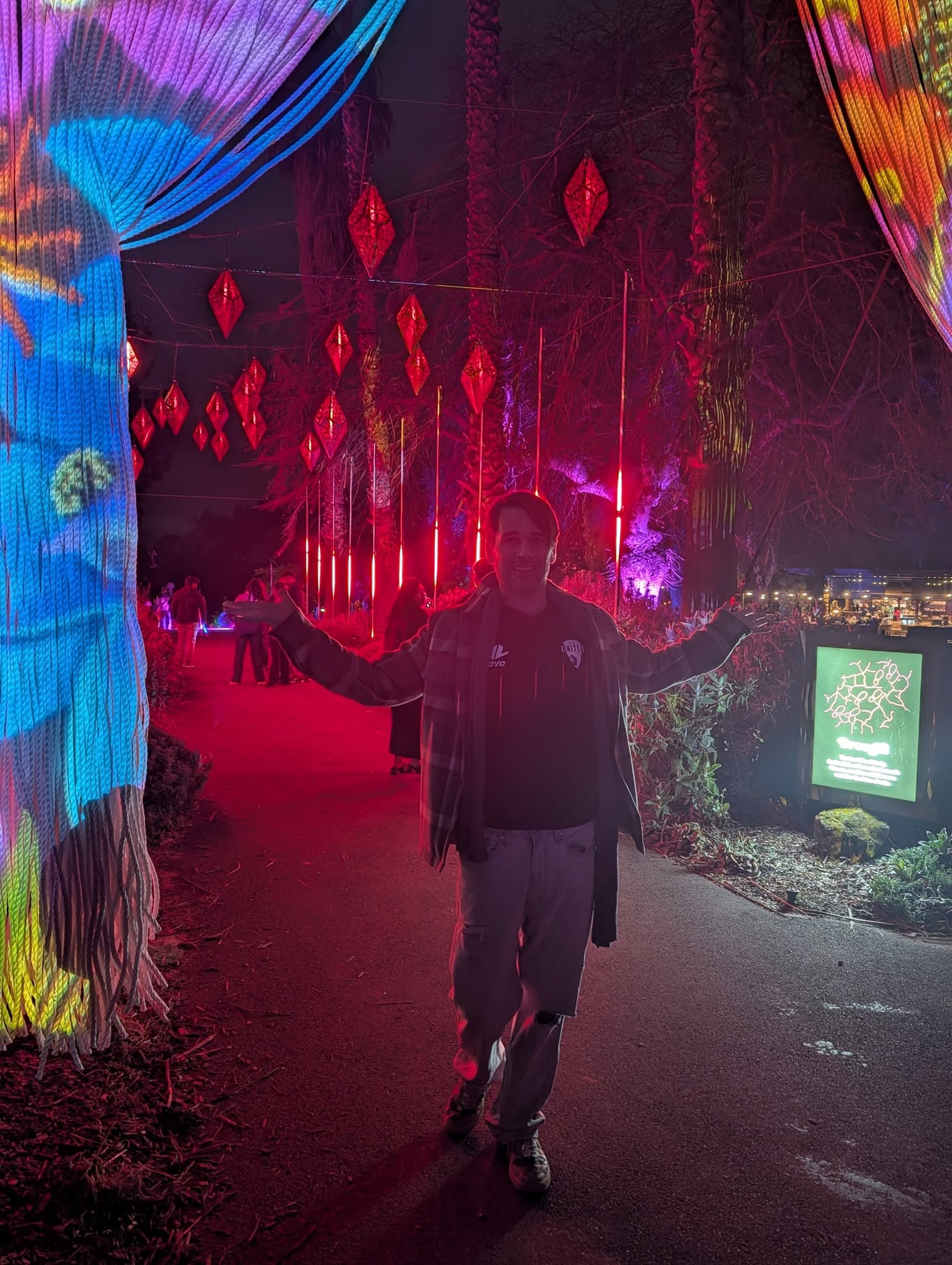
Congratulations to the City of Greater Geelong and the incredibly talented creative team behind the Geelong Botanic Gardens light experience.
With tonight marking the final evening, it feels a little nostalgic. Around two years ago, I pitched this concept to the City and even began promoting the vision with support and proposed investment from a major international cinema company. While that project ultimately took a different path, it has been genuinely exciting to see the City develop a local version that has captured the imagination of our community.
Most importantly, Geelong embraced it. Thousands of locals and visitors came together to experience something unique, supporting tourism, local businesses and showcasing what our region can achieve when we invest in creative experiences.
01 / Why I'm gladThe local version was the right one.
I could be sour about this. A pitch I put real work into, with international money attached, and the thing that eventually got built wasn't mine. That's the version of this story some people would tell.
But it would be the wrong one — because the local version has an advantage the imported one never would have had.
Figure 01 · Two ways to do the same idea
Imported spectacle versus local creative capacity.
Buy it in
- Fast — a proven format arrives ready to install
- Polished — international production values from night one
- Money leaves — licensing and fees flow out of the region
- No local capability built — when it ends, nothing remains
- Generic — the same experience as fifteen other cities
Make it here
- Slower — you have to develop it, not just book it
- Distinctive — designed for these gardens, these trees
- Money stays — local designers, fabricators, technicians, crew
- Capability compounds — the team can do it again, better
- It belongs to us — which is why people turned out
Both approaches are legitimate. But a region that only ever buys experiences in never develops the people who can make them.
Congratulations to everyone involved in bringing this to life. It is a fantastic example of how arts, culture and nature can come together to create memorable experiences for our community.
A region that keeps importing its cultural experiences stays a market. A region that learns to make them becomes a producer. The second one is worth far more over twenty years.— David Greenwood OAM
02 / The Serendip ideaIts original intended home.
I look forward to seeing how this event continues to evolve in the years ahead. Perhaps one day we'll even see a version at its original intended home, Serendip Sanctuary in Lara, where the natural environment would create an equally magical backdrop.
That was where the concept started, and I still think the case is strong. Serendip has something the Botanic Gardens can't offer: genuine open wetland, native grassland, and a bush setting with resident wildlife — the kind of landscape that a light installation could work with rather than simply decorate.
Figure 02 · Why Serendip
Four reasons the northern site still makes sense.
| Argument | Detail |
|---|---|
| A different landscape | Wetlands, native grassland and open bush produce a fundamentally different experience to a formal garden — reflections on water, long sightlines, and a genuine sense of being out in country. |
| Spreading the benefit north | Major events in this municipality concentrate heavily around the CBD and waterfront. An event of this scale in Lara would direct visitors, spending and attention to the northern end of the region. |
| Existing infrastructure | Serendip is an established visitor site with parking, paths and interpretive facilities. The bones are there. |
| A reason to visit Lara | Thousands of people drive past Lara on the highway every day. Very few have a reason to turn off. A signature seasonal event is exactly that reason. |
Any event at a conservation site would need genuine environmental assessment and the agreement of the land managers — wildlife, habitat and seasonal sensitivity would have to come first, not second.
03 / The broader pointWhat this says about investing in creative experiences.
The thing worth taking from this isn't the light installation. It's the demonstration that Geelong will turn out in serious numbers for a well-made cultural experience — and that when it does, hospitality, retail and accommodation all feel it.
That's an argument I'll keep making. Arts and cultural investment gets treated as discretionary spending, the first thing trimmed when a budget tightens. But an event like this produces measurable economic activity, builds local creative capability, and gives residents a reason to be proud of where they live. Very few line items do all three.
Well done to everyone involved.