I live in Lara. Between the You Yangs, the grassland to the north and west, and a summer that reliably delivers days of extreme heat and northerly wind, this is a fire landscape. Not a theoretical one.
The single most important thing I can say in an article like this is that nothing written here replaces official information on the day. What follows is preparation. Decisions belong to VicEmergency, the CFA and you.
For current warnings and incident information use the VicEmergency app and website and the VicEmergency Hotline. In an immediate life-threatening emergency, call 000.
Do not rely on social media, word of mouth, or a website like this one for real-time decisions. Official sources are updated by people with access to information you don't have.
01 / GrassfireThe risk people underestimate here.
When people picture bushfire they picture forest. Much of the risk around Lara, Little River, Anakie, Batesford and the Moorabool corridor is grassfire — and grassfire behaves differently in ways that matter.
Figure 01 · Fire behaviour
Why grassfire catches people out.
It moves fast
Grassfire can travel considerably faster than fire in forest. The window between "there's smoke" and "it's here" can be very short indeed on a windy day.
Wind changes are the danger
A southwest change turns a long narrow fire flank into a wide new fire front. People who felt safe because the fire was "going the other way" are the ones most often caught.
It reaches houses on open ground
Being on a rural block with no trees nearby is not protection. Radiant heat and ember attack still threaten structures, and grass right up to a fence line is fuel.
Curing matters
Grass dries out through summer. The same paddock is a very different hazard in November and in February. Risk isn't static across the season.
02 / The decisionLeaving early is the plan.
Emergency services are consistent and unambiguous on this: leaving early is the safest option. Not "leaving when you see flames" — leaving before there is a fire near you, on days when conditions are dangerous.
Staying to defend a property is an extremely demanding undertaking that requires physical fitness, equipment, independent water supply, protective clothing, and a well-prepared property. Most people who intend to stay have not actually prepared to the standard required, and the decision often gets made under conditions of heat, smoke, noise and fear that degrade judgement badly.
Figure 02 · Your plan
Decide these things in advance, in writing.
Write it down and put it somewhere everyone in the household can find. A plan that exists only in one person's head is not a household plan.
Almost nobody intends to leave late. They intend to leave, and then something takes twenty minutes longer than expected — the dog, the paperwork, one more sprinkler. Decide the trigger in advance and treat it as non-negotiable. — David Greenwood OAM
03 / The propertyPreparation that actually reduces risk.
Figure 03 · Property preparation
Before the season, and through it.
Before summer
- Clear gutters of leaves and debris — a classic ember trap
- Cut grass short and keep it short, right to the boundary
- Move firewood, mulch piles and flammable stored goods away from the house
- Check and repair gaps in eaves, vents and under decking where embers enter
- Trim overhanging branches and remove dead vegetation
- Know your water supply and whether it works without mains power
On a high-risk day
- Check official warnings early — before you make plans for the day
- Keep the car fuelled and facing out, keys accessible
- Dress for it if you're outdoors — long sleeves, natural fibres, sturdy boots
- Keep phones charged and carry a backup battery
- Don't start work that could create a spark — slashing, grinding, welding
- Check on neighbours who are older, isolated or without transport
Council enforces fire prevention notices on properties with excessive fuel loads. If a vacant block near you is a hazard, report it to the City of Greater Geelong — that's a real and effective mechanism.
04 / The documents boxFifteen minutes now, enormous relief later.
One container, packed before summer, that you can pick up and carry. Passports, birth certificates, insurance policies, property title, medications and prescriptions, a list of important phone numbers on paper, a USB or cloud backup of photographs, spare glasses, and enough cash to function if card systems are down.
People who have lived through a fire almost universally say the same thing afterwards: the things they grieved were the irreplaceable personal items, and those were the things a box would have saved.
05 / CommunityThe part council and neighbours own.
Figure 04 · Shared responsibility
What sits with whom.
| Responsibility | Who holds it |
|---|---|
| Warnings, incident information and firefighting | CFA, Fire Rescue Victoria and emergency management agencies, via VicEmergency |
| Fire prevention notices on private land, and roadside fuel on local roads | City of Greater Geelong — report hazards to council |
| Fuel management in the You Yangs Regional Park | Parks Victoria |
| Major road and arterial roadside management | Department of Transport and Planning |
| Your own property, plan and decision to leave | You |
If you're not sure who is responsible for a hazard you can see, tell council anyway — they will refer it. A reported hazard that goes to the wrong agency is far better than an unreported one.
And the local part that isn't anyone's official job: knowing your neighbours. Who lives alone. Who can't drive. Who has mobility needs, or animals, or no family nearby. On a bad day that knowledge does more good than any amount of equipment.
I'd also say plainly, and with a personal interest declared: our CFA volunteers turn out on the worst days of the year for nothing. My own family are among them. Whatever else this region argues about, supporting the brigades — with recruitment, with equipment funding, with proper facilities, and with genuinely respecting their advice — should not be contested.
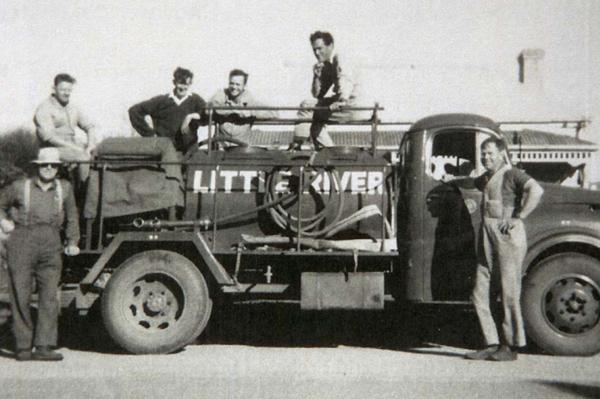
The photograph at the top of this article is a Little River crew from an earlier era. What strikes me about it is how little the essential arrangement has changed: local people, a truck, and a willingness to go out. Brigades across the You Yangs Ward — Lara, Little River, Anakie, Batesford and their neighbours — still run on exactly that. If you've ever thought about joining, they will genuinely welcome you, and not every role involves being on the truck.
If you can see an unmanaged fire hazard in the You Yangs Ward — a vacant block with heavy grass, an overgrown roadside, a blocked access track — report it to the City of Greater Geelong. If you've reported it and nothing has happened, send me the reference number and I'll chase it. Email david@centrestage.org.au with "Fire hazard" in the subject.