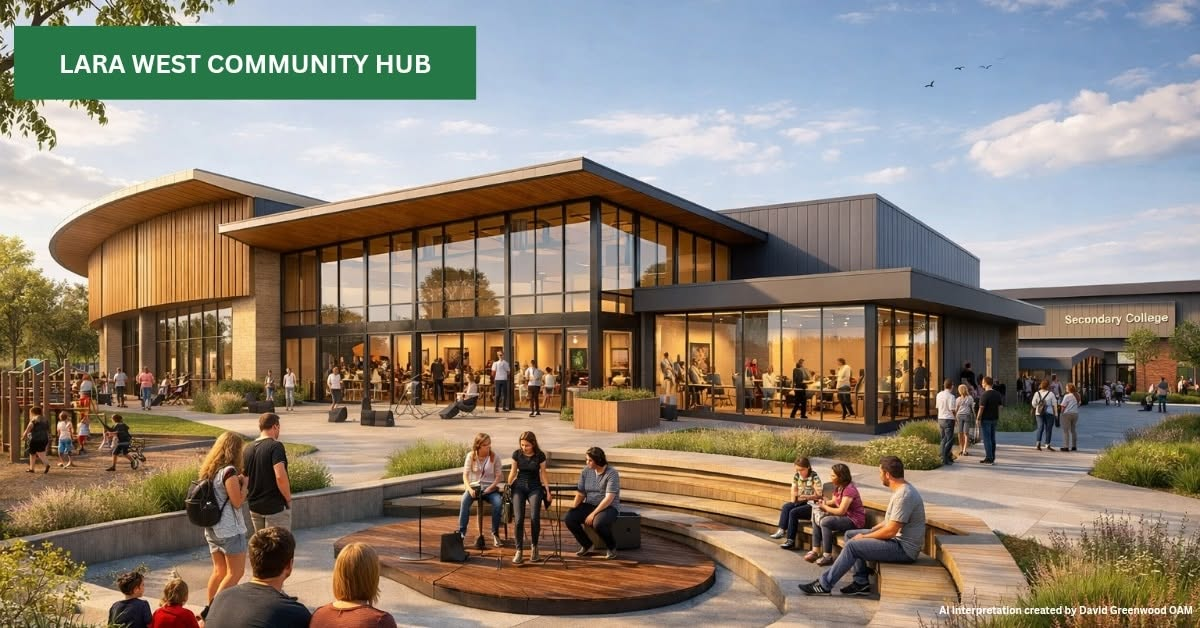
Lara is growing rapidly, and our community infrastructure needs to grow with it in a way that truly reflects local needs.
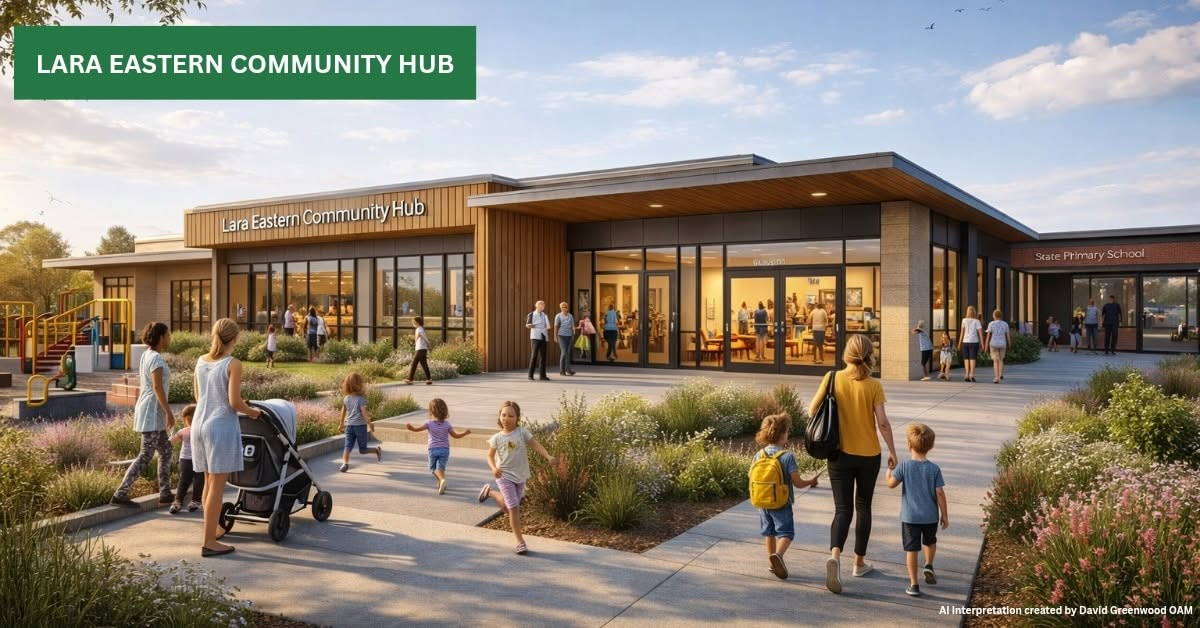
These concept mock-ups for the proposed Lara West and Lara East Community Hubs illustrate what is possible when we move beyond one-size-fits-all buildings and instead design spaces around how people actually live, gather, learn, and connect.
Both images on this page are concept interpretations I created myself to show what's possible. They are not official renders, not endorsed plans, and not the work of the City or the Victorian School Building Authority.
I've published them because a conversation about design goes better when people have something to react to than when they're asked to imagine a building from a list of room names.
01 / What's proposedThe two hubs as currently described.
Figure 01 · Proposed inclusions
Two hubs, each co-located with a new state school.
With the new State Primary School
- Kindergarten rooms
- Maternal and child health spaces
- Consulting suites
- Meeting rooms
- A childcare centre
With the new State Secondary School
- Kindergarten rooms
- Youth spaces
- Consulting rooms
- General activity areas
- Recognition that a civic or cultural space may also be required
Inclusions are as currently proposed and subject to change. While these inclusions are a strong starting point, how these spaces are designed and connected will determine whether they truly work for the community long-term.
02 / The real questionDesign and connection, not room lists.
A list of rooms tells you very little about whether a building will work. What matters is how the spaces relate to each other, whether they can be used outside school hours, whether a community group can book one without a fight, and whether the place invites people in or just houses services.
Figure 02 · What decides whether a hub works
Five design questions worth answering early.
| Question | Why it decides the outcome |
|---|---|
| Can community access it when the school is closed? | Co-location is efficient, but a hub that's only reachable through school grounds during school hours isn't a community facility. Separate entry, separate hours, separate booking. |
| Is there genuinely flexible space? | Rooms designed for one named service sit empty the rest of the week. Space that can host a kinder session, a committee meeting, a rehearsal and a health clinic gets used ten times more. |
| Is there anything outdoors that works? | Sheltered outdoor space that can hold a market, a performance or a gathering multiplies what the building can do — at a fraction of indoor cost per square metre. |
| How do you get there without a car? | Safe, lit, continuous paths from the surrounding streets. A hub reachable only by car excludes the young people its youth spaces are built for. |
| Who holds the keys? | Booking systems, fees and permissions determine actual use more than architecture does. A beautiful hall nobody can afford to book is a beautiful empty hall. |
03 / The askA Community Liaison Reference Group.
That is why I am advocating for a Community Liaison Reference Group. Local residents, young people, families, educators, artists, and service providers must be involved early, so these buildings are shaped with locals at heart rather than delivered as cookie-cutter facilities that do not reflect Lara's character or needs.
I've served on a reference group of this kind for a major community facility in the north, and I've seen what it changes. Not everything — the engineering and the budget still bind. But the questions a reference group asks early are exactly the ones that are expensive to fix late.
The cheapest time to influence a building is before it's designed. The most common time communities are consulted is after it's designed.— David Greenwood OAM
04 / Developer contributionsWhy transparency matters here.
These hubs, alongside other essential local improvements, are being funded through developer contributions. With projects of this scale, transparency is critical.
Developer contributions are money collected from development in a growth area, to be spent on the infrastructure that growth makes necessary. In principle it's a sound mechanism. In practice, residents in growth corridors routinely watch houses arrive years ahead of the facilities the contributions were meant to fund — without ever being able to see how much has been collected, what it's committed to, or when.
Figure 03 · What I'm pushing for
Three reporting improvements.
People can accept a delay they understand. What corrodes trust is money collected from local development with no visible account of where it went.
If we are investing in Lara's future, we must do it properly, collaboratively, and with long-term value in mind.
What would you love to see in these new buildings? A rehearsal space? A commercial kitchen? Somewhere teenagers can actually go on a Wednesday evening? A room a small group can book for twenty dollars? Tell me — and if you'd like to be part of a reference group pushing for it, say so. Email david@centrestage.org.au with "Lara hubs" in the subject.