Developer contributions are one of the least understood and most consequential mechanisms in local government. They're the reason a new estate arrives with roads and a reserve rather than nothing at all — and, when they go wrong, they're the reason a community waits fifteen years for a pavilion that was promised on the day the land was rezoned.
01 / What was actually approved
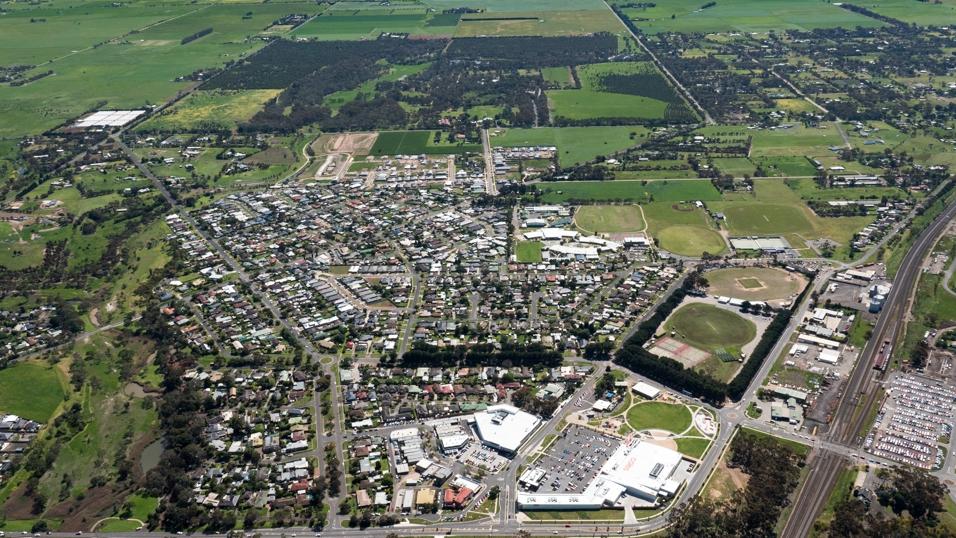
Amendment C246 rezoned the Lara West land to the Urban Growth Zone and was gazetted on 27 February 2014. It brought with it a Precinct Structure Plan, a Native Vegetation Precinct Plan, and a Development Contributions Plan Overlay. The land sits within the area bounded by Bacchus Marsh Road, Patullos Road, Windermere Road and O'Hallorans Road.
The Lara West Development Contributions Plan itself dates from March 2014 and was approved as part of Amendment C285. Those two documents — the PSP and the DCP — are the source of every promise made about what Lara West would deliver.
Figure 01 · What Lara West was approved to deliver
The 2014 promise, in numbers.
| Element | As planned |
|---|---|
| Land area | Approximately 390 hectares |
| Future population | Around 11,000 people |
| New homes | Approximately 4,000 |
| Infrastructure investment | Around $37 million — roads, community infrastructure, sporting grounds |
| Schools | Three new schools |
| Employment precinct | Around 300 jobs |
| Neighbourhood activity hub | Around 185 ongoing jobs |
| Public transport | Lara station upgraded to a modern transport interchange |
Source: City of Greater Geelong Lara West growth area documentation and the approved Precinct Structure Plan, February 2014. The $37 million figure is expressed in 2014 terms — which becomes one of the central problems discussed below.
02 / Where the money actually comes from
There isn't a single "developer fund" — there are two distinct levies, collected at different moments from different parties, and confusing them is the source of most public misunderstanding about how this works.
Development Infrastructure Levy
- Paid by the developer, per developable hectare
- Calculated by dividing total development infrastructure cost by net developable area
- Payable — or offset by approved works-in-kind — before council issues a Statement of Compliance for a subdivision stage
- Funds roads, intersections, drainage, path networks
Community Infrastructure Levy
- Paid by the landowner (unless the developer has agreed to cover it), per dwelling
- Payable before a building permit can be issued for a new dwelling
- Under section 24 of the Building Act 1993, a building surveyor cannot issue that permit until it's paid
- Funds community infrastructure — pavilions, libraries, community centres
The practical significance of that split is timing. DIL money arrives as land is subdivided, relatively early in an estate's life. CIL money arrives dwelling by dwelling, as houses are actually built — which means the fund for the community centre fills up slowly, over a decade or more, house by house.
03 / The works-in-kind question
A developer can satisfy their DIL obligation not by paying cash but by building the infrastructure themselves and claiming a credit against what they owe. This is entirely legitimate and often sensible — the developer already has machinery on site, and a road built as part of the subdivision is cheaper than the same road built separately later.
But works-in-kind arrangements are where transparency most often breaks down. The value credited against a developer's obligation is a negotiated figure. If it's set generously, the developer discharges a larger obligation for a smaller real contribution, and the shortfall lands on the fund available for everything else. There's nothing improper about the mechanism — but there is a genuine public interest in the credited values being visible, and in most councils they simply aren't published.
Figure 02 · How a promised facility gets delayed
The sequence, step by step.
This is the standard failure pattern in Victorian growth areas, not something unique to Lara West. But knowing it's structural doesn't make it acceptable — it makes it predictable, which means it can be planned around if a council chooses to.
04 / The indexation problem, specifically
Council's own material confirms the levy is "calculated and indexed each year to ensure these levies keep pace with the escalating cost of these projects." That's the right intention. The question is whether the indexation method actually achieved it across a decade that included an unusually severe construction cost shock.
If a pavilion was costed at, say, $2 million in 2014 and the indexation applied delivered $2.6 million by the time it was built, while the real cost of that pavilion had reached $3.5 million, then the fund is short — and the shortfall has to come from general rates, or the project shrinks, or it waits. None of those three outcomes involve anyone acting improperly. All three mean the community gets less than the plan promised.
This is a genuinely answerable question, and it's answerable from documents council already holds. It's the first thing I'd want on the public record.
05 / What I'm not going to claim
I want to be careful here, because this is exactly the kind of topic where a candidate can generate attention by implying more than they can prove.
I don't have verified figures for how much has been collected into the Lara West DCP fund to date, how much has been spent, what remains, or which specific projects have slipped and by how long. Those figures exist — councils are required to keep DCP accounts and report on them — but I'm not going to publish numbers I haven't sourced, and I'm not going to characterise delays as a scandal when the more likely explanation is the structural sequencing and indexation problem described above.
What I will say plainly: the fact that residents have to ask these questions at all, more than a decade after the plan was approved, is itself the problem. A DCP fund should be as visible as a bank statement.
Figure 03 · The questions worth answering
Six things that should be public.
Total collected to date
DIL and CIL separately, cumulative since 2014, for the Lara West DCP.
Total spent, by project
Which projects in the plan have been delivered, at what cost, and when.
Current fund balance
What's held, and what it's earmarked for.
Works-in-kind credits granted
Which developers, which works, and what value was credited against obligation.
The indexation gap
Original 2014 project costings versus current estimated delivery costs, project by project.
Revised delivery timeline
For every project not yet built: the expected year, and what population or funding threshold triggers it.
None of this requires new work. It requires publishing what already exists in council's DCP accounts in a format a resident can read.
06 / Why the station upgrade matters most
Of everything in the 2014 plan, the commitment that a growing Lara West would be supported by an upgraded Lara station "transport interchange" is the one with the widest consequences — and it's also the one least within council's control, since rail infrastructure is a state responsibility rather than something a DCP can fund outright.
That's the awkward seam in the whole model. A precinct structure plan can describe an integrated community with good public transport. But the DCP can only fund the local infrastructure council is responsible for. Schools, rail and bus services all sit with the state, on separate funding cycles, with no obligation to match the timeline the PSP implied. When residents feel a plan wasn't delivered, the gap is often in that seam — between what the plan described and what any single level of government was actually committed to fund.
07 / What I'd actually push for
Four specific things, none of which require a change in state law:
Publish the fund
- An annual, plain-English public statement for each active DCP: collected, spent, held, and committed
- Works-in-kind credits disclosed with the value attributed
- Original costing versus current cost, per project
Bring facilities forward
- Investigate borrowing against forecast contributions so community facilities land early in an estate's life, not at the end
- Publish a dated delivery schedule for every outstanding project
- Formally report the indexation shortfall so the funding gap is acknowledged rather than absorbed quietly
A development contributions fund is money collected from the community, for the community, on a written promise. It should be as easy to check as a bank statement.— David Greenwood OAM