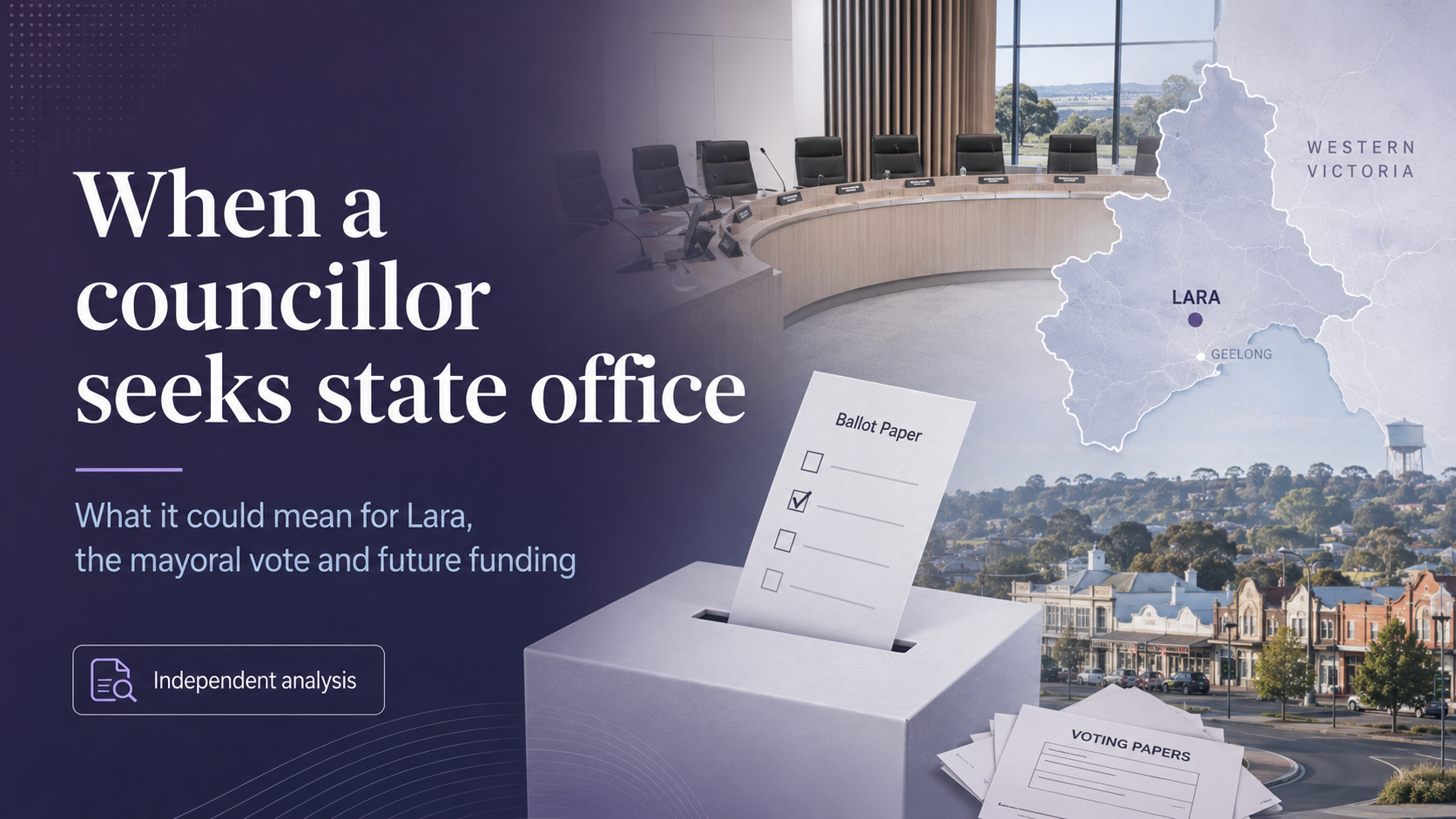
With another Victorian election approaching, there will be plenty of discussion about leaders, parties, policies, polls and personalities. But underneath all of that is a much simpler question we probably do not talk about enough: what are we actually voting for?
When we vote in a council election, are we voting for a Mayor? When we vote in a state election, are we voting for a Premier? When we vote federally, are we voting for a Prime Minister? What does the Upper House do? Why do we receive two ballot papers? What happens to preferences? And why can a government win an election but still struggle to pass legislation?
Because regardless of where we sit politically, democracy works better when we understand what our vote is actually doing.
Information in this article is current as at 8 August 2026.
Victorian Upper House voting laws are currently subject to proposed reform, which is explained in full further down this page.
01 / The basicsThere are three levels of government.
One of the easiest places to become confused is the language. Australia has three levels of government — and the Upper House and Lower House are not additional levels. They are two different chambers within our state and federal parliaments.
Figure 01 · The three levels
Three levels of government — and two chambers inside two of them.
Local government — City of Greater Geelong
Your local community and municipal services. One chamber: the council. Established and regulated under state legislation.
State government — Victoria
Services and laws operating across Victoria. Two chambers: Legislative Assembly (Lower) and Legislative Council (Upper).
Federal government — Commonwealth of Australia
National laws, services and responsibilities. Two chambers: House of Representatives (Lower) and the Senate (Upper).
Australia's system divides responsibilities between the Commonwealth, the states and territories, and local councils. There is also considerable overlap, particularly where one level funds a service another level administers.
That distinction matters, because politicians are frequently asked to fix things that are not actually within the direct control of the body to which they have been elected.
02 / LocalWhat does council actually do?
For those of us in Greater Geelong, local government is the City of Greater Geelong. Council deals most directly with things happening within our municipality — local roads, rubbish and recycling, parks and sporting facilities, libraries, planning, local laws, community facilities, animal management and a wide range of local services.
So if your concern is a local park, a council facility, a local planning decision, neighbourhood amenity or many local roads, your councillor and council are often the logical starting point.
But councils differ from state and federal governments in an important constitutional sense. Local government is established and regulated under state legislation. It is not a separate sphere of government created by the Australian Constitution in the same way as the Commonwealth and the states. So while councils can advocate strongly on hospitals, public transport, policing or federal funding, they do not gain the legal powers of the Victorian or Australian governments simply because an issue matters locally.
Figure 02 · Greater Geelong
You elect one councillor. The councillors elect the Mayor.
Common assumption
"I'm voting for the Mayor of Greater Geelong."
What actually happens
You elect your ward councillor. They then vote on who becomes Mayor.
This is why the composition of the whole council matters, even though each voter elects only one councillor.
03 / StateWhat does the Victorian Government do?
The Victorian Government deals with matters applying across Victoria — hospitals, education and training, police and crime prevention, public transport, roads and road safety. States also have substantial responsibilities for prisons, ambulance services, water and various community services.
Victoria's next scheduled state election is Saturday, 28 November 2026. At that election, Victorians will actually make two separate choices.
Figure 03 · Two ballot papers
Two ballots. Two entirely different jobs.
Legislative Assembly
- 88 members, one per district
- Elected by preferential voting
- You elect one local MP
- This chamber determines who forms government
- The Premier sits here
Legislative Council
- 40 members across 8 regions
- Elected by proportional representation
- Each region elects five members
- This chamber reviews legislation
- Government does not need a majority here
Those two votes do different things — your Upper House vote is not a duplicate of your Lower House vote.
04 / Lower HouseThis is where government is formed.
Victoria's Legislative Assembly has 88 members representing 88 districts, with one MP elected from each district for a four-year term. The political party or coalition that can command a majority forms the Victorian Government. A majority of 88 seats is 45.
Figure 04 · Victorian Legislative Assembly
88 districts. 45 seats forms government.
Each circle is one district. Every voter in Victoria elects exactly one of them — and the sum of those 88 separate contests decides who governs.
The name of the person you want to be Premier is not placed on every Victorian ballot paper. You vote for candidates seeking to become your local Member of the Legislative Assembly. — The most commonly misunderstood part of Australian elections
Those 88 individual district contests determine the composition of the Lower House. From that collection of seats comes the government. So when media coverage says an election is a contest between two prospective Premiers, that is politically understandable — but technically our ballots are electing local MPs. The Premier emerges from the parliamentary numbers those individual elections produce.
That distinction becomes particularly important when an election produces a very close parliament, or no single party holds a majority.
05 / Upper HouseA very different vote.
Victoria's Legislative Council has 40 members. Victoria is divided into eight Upper House regions, and each region elects five members. Unlike the Lower House, which elects one representative per district, Upper House members are elected using proportional representation.
Figure 05 · Victorian Legislative Council
8 regions × 5 members = 40 seats.
The Legislative Council acts as a house of review. It debates legislation, scrutinises government, and can pass, amend or reject most bills. Critically, the government does not need to hold a majority here to form government.
That means voters can produce one political result in the Lower House and a very different political balance in the Upper House — and that can substantially affect how a government operates. A government might have the numbers to govern in the Legislative Assembly but not enough votes to pass legislation through the Legislative Council without negotiating with the Opposition, minor parties or independents.
This is where the expression "balance of power" becomes important. A small number of Upper House MPs can become pivotal, because their votes determine whether legislation passes, changes or fails. So your Upper House vote can help determine how much negotiation and scrutiny a government faces once it has been elected.
06 / FederalThe same principle, larger numbers.
At a federal election, Australians also elect two different chambers — the House of Representatives (Lower) and the Senate (Upper). Again, they perform different roles.
Figure 06 · House of Representatives
150 electorates. 76 seats forms government.
The Australian Electoral Commission confirmed in July 2026 that the House will remain at 150 seats for the next federal election. When you receive the smaller green ballot paper, you are choosing who represents your electorate — you are not directly electing the Prime Minister.
The party or coalition that has the support of a majority of members in the House forms government, and its leader becomes Prime Minister. Australian elections are not presidential elections. There is no national ballot asking "Who should be Prime Minister?" Instead, millions of Australians participate in 150 separate contests. The results determine the numbers in Parliament. Those numbers determine who can form government.
This also explains something else about election results. A party's national percentage of the vote is not, by itself, what determines who forms government. What matters in the Lower House is how votes translate into individual electorate results — and therefore seats. It is mathematically possible for support to be distributed in ways that mean the party receiving the largest nationwide primary vote does not win the largest number of seats. That is because Australia elects representatives electorate by electorate, rather than treating the nation as one giant electorate.
Figure 07 · The Australian Senate
76 senators — 12 per state, 2 per territory.
The Senate is a particularly powerful Upper House. Bills generally need to pass both houses before becoming law. It can examine, amend and reject legislation — though special constitutional rules apply to taxation and certain spending bills — and it operates an extensive committee and estimates system used to scrutinise government decisions and expenditure.
But winning the Senate does not make a party the government. Government is determined by confidence in the House of Representatives. This creates an important distinction:
Your Lower House vote
Helps determine who governs.
Your Upper House vote
Helps determine the parliamentary environment in which they govern.
Sometimes voters elect a government with a strong Lower House majority while giving it no majority in the Senate. That is not a contradiction — it is one of the ways Australia's two-house parliamentary system distributes political power.
07 / Why crossbenchersSmaller parties are often stronger in Upper Houses.
The voting system matters. In a Lower House electorate, only one candidate can ultimately win. In an Upper House contest, multiple representatives are elected. Proportional representation therefore gives candidates and parties with a smaller share of the vote a greater opportunity to secure representation than they would generally have in a single-member electorate. The Australian Parliament itself notes that proportional Senate voting makes it easier for independents and smaller parties to be elected.
This can make Upper Houses more politically diverse. It can also mean governments need to negotiate with crossbenchers to pass legislation. Whether someone considers that a valuable check on government or an obstacle to implementing an elected government's agenda is a matter of political philosophy. Both arguments are legitimate democratic positions — but understanding why it happens is important.
08 / PreferencesSo how do they actually work?
This is another area where myths tend to circulate. In a federal House of Representatives election, voters must number every candidate in order of preference.
Figure 08 · Preference distribution
What happens when nobody wins outright.
A first preference for an independent or minor-party candidate is not automatically a wasted vote simply because that candidate does not ultimately win. If your first choice is eliminated, your ballot continues according to the preferences you numbered.
A party can hand you a how-to-vote card recommending where preferences should go, but at federal Lower House elections the numbers you write on your ballot determine where your vote travels. You are free to follow a party's recommendation, ignore it entirely, or create your own order.
09 / Senate preferencesThe federal Senate works differently again.
For the Senate, voters can vote above or below the line. Under the current federal system, voters are instructed to number at least six boxes above the line, or at least 12 candidates below the line.
This is significant, because the federal Senate no longer uses the old group voting ticket system, under which a single above-the-line vote could hand control of subsequent preferences to a political party. Federal voters now directly indicate their preferences.
10 / Watch this oneVictoria's Upper House currently has a major difference.
This is particularly relevant ahead of the 2026 Victorian election. Under the Victorian Electoral Commission's currently published voting instructions, a Victorian Upper House voter who votes above the line places a number 1 beside a group. The voter's preferences are then distributed according to a group voting ticket registered by that group. Alternatively, a voter can vote below the line and number at least five individual candidates, which allows the voter to determine those preferences personally.
Legislation to abolish Victorian Upper House group voting tickets has passed the Legislative Assembly and is before the Legislative Council.
The proposed system would require voters choosing to vote above the line to number at least five groups in their own order of preference. The bill had its second reading moved in the Legislative Council on 30 July, with debate adjourned, and Parliament resumes sitting on 11 August. It has therefore not yet completed passage through Parliament as at the date of this article.
The practical message for voters: check the VEC's official instructions before completing your 2026 Upper House ballot, because the rules may change before election day.
11 / Close resultsWhat happens if nobody wins a majority?
This is where the words "hung parliament" or "minority government" enter the discussion. Under our Westminster parliamentary system, the crucial question is ultimately who can command the confidence of the Lower House. A party does not necessarily need an outright majority in its own right if it can secure enough support from independents or other parties to govern.
This is why crossbench MPs can become particularly important after a close election. Their support on matters such as confidence and supply can determine who is able to form and maintain government. Importantly, supporting a government on confidence does not mean a crossbencher is required to support every piece of legislation that government proposes.
So an election does not always finish neatly on election night with one side winning everything. Sometimes voters collectively produce a parliament in which compromise and negotiation become necessary.
12 / The summaryWhere does your vote have the most influence?
There is no universal answer, because each ballot is doing something different. A useful way of looking at it is this:
Figure 09 · What each ballot does
Six ballots. Six different jobs.
| When you vote for… | You are primarily influencing… |
|---|---|
| A Greater Geelong councillor | Your ward's representation, and the collective composition and decisions of Council — including who becomes Mayor. |
| Victorian Legislative Assembly | Your local state MP, and who is able to form the Victorian Government. |
| Victorian Legislative Council | The balance of the state's house of review, and how easily legislation can pass. |
| Federal House of Representatives | Your federal MP, and who is able to form the Australian Government. |
| Australian Senate | National legislative scrutiny, representation, and the balance of power in the Upper House. |
| A referendum | Whether the Australian Constitution itself should be changed. |
13 / ReferendumsA referendum is different again.
In a referendum, we are not electing a politician at all. We are voting directly on a proposed change to the Australian Constitution. To succeed, a constitutional referendum requires what is known as a double majority.
Figure 10 · The double majority
Both tests must pass. One alone is not enough.
Territory votes count towards the national majority but not the four-state component. A referendum is one of the relatively rare occasions when Australians directly answer a national Yes or No constitutional question, rather than electing representatives to decide on their behalf.
14 / OverlapSome issues do not fit neatly into one box.
Another reason politics can become confusing is that the different levels of government often overlap. Take roads. A local council may manage local streets. The Victorian Government manages major state roads and transport networks. The Commonwealth may provide significant funding towards major infrastructure.
Health is another example. States operate public hospitals, but the Commonwealth provides major funding and operates national programs. Education, housing, environmental policy and infrastructure can similarly involve multiple levels of government.
Figure 11 · Four questions
When a project is announced, ask these four things.
Who owns it?
Which level of government holds the asset or the land?
Who operates it?
Who runs the service day to day, and employs the staff?
Who funds it?
Where did the money come from — council rates, state budget, Commonwealth grant?
Who decided?
Which body actually made the decision to proceed?
Sometimes those are four different answers. Understanding that makes it easier to hold the correct level of government accountable.
15 / HistoryIt is worth remembering that voting rights were fought for.
Our electoral system did not always include everyone equally. For First Nations Australians, the history is particularly significant. Aboriginal and Torres Strait Islander peoples faced different voting restrictions across Australian jurisdictions for generations.
Commonwealth electoral law was amended in 1962 to extend the right to enrol and vote in federal elections to all Indigenous Australians. Compulsory enrolment and voting on the same basis as other Australian citizens followed in 1984. Queensland had been the last state to extend state voting rights to Aboriginal and Torres Strait Islander peoples, doing so in 1965.
Understanding our democracy should include understanding that access to it was not always equal, and that generations of Australians advocated for the right to participate in decisions affecting their communities.
16 / One more mythDoes voting for a candidate mean endorsing everything their party believes?
No election can reduce millions of individual opinions into a perfectly precise result. Someone might support a local candidate but disagree with their party on a national issue. They might prefer one party in the Lower House but another in the Upper House. They might place an independent first and a major party second. They might vote primarily on health, education, cost of living, infrastructure, the environment, taxation, social policy or local representation.
That is precisely why we have ballots, rather than assuming everybody thinks identically. There is also nothing unusual about voting differently across different levels of government. A council election, a state Lower House election and a federal Senate election are asking different democratic questions.
Figure 12 · Before any election
Five questions worth asking.
| Question | Why it matters |
|---|---|
| What position am I actually voting for? | A councillor, state MP, federal MP and senator have very different powers. |
| Does this level of government control the issue I care about? | It helps separate achievable commitments from political advocacy. |
| Who is the local candidate? | In our system, we elect representatives — not simply party brands or leaders. |
| Where will my preferences go? | Preferential voting means your second, third and later choices can matter. |
| What do I want this particular chamber to do? | Form government, represent my community, review legislation, or provide a check on government? |
None of those questions tells anyone who to vote for. They simply make the decision more informed.
17 / The big oneWe are not voting for a government. We are electing a parliament.
Perhaps this is the biggest takeaway. We often talk about elections as though we are selecting one person to run everything. We are not.
At state and federal elections, one part of that parliament determines who can form government. Another part reviews legislation and can force negotiation. Individual MPs represent geographic communities. Senators and Upper House members represent much larger electorates through proportional voting. Local councillors collectively govern municipalities.
At every level, power is divided. That can sometimes make government slower and messier than we might like. But the alternative would be concentrating substantially more political power in far fewer hands. — David Greenwood OAM
18 / The bottom lineYou are not casting the same vote every time.
You are generally not directly electing a Mayor, Premier or Prime Minister simply by selecting their name or party. You are participating in a system where thousands — and sometimes millions — of individual choices combine to determine who represents us and how political power is distributed.
Whether you vote Labor, Liberal, National, Greens, for a minor party, an independent, or construct a completely different preference order is an individual decision. Understanding the system does not tell us what political choice to make. It simply means we can make that choice knowing what our ballot actually does.
And perhaps before the next election, the most useful question is not simply "Who do I want to win?" It might be:
"What am I voting for on this particular ballot, what power will that person actually have, and where will my preferences go?"