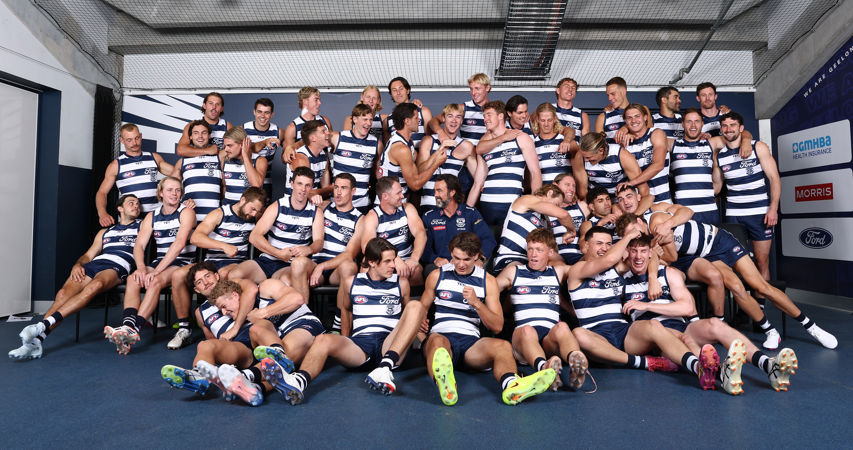
There are few Australian cities where the fortunes of a football club are as closely tied to the identity of the city as they are in Geelong.
When the Cats are winning, you can feel it. Flags appear in shop windows. Conversations at work change. Crowds grow. The city feels busier, more confident and, for a few weeks at least, remarkably united around the same cause. When Geelong loses a Grand Final, the opposite can be equally noticeable.
So it raises a fascinating question. Does the performance of the Geelong Football Club, particularly around Grand Final time, have any relationship with how Geelong votes or who ends up leading the city?
It sounds like something that belongs in the realm of pub conversation rather than political analysis. But there is actually international research examining precisely this broader question. And when Geelong's football history is placed beside our local political history, there are enough coincidences to make the exercise genuinely interesting.
Correlation is not causation. There is no evidence that winning a premiership causes Geelong residents to elect a particular councillor, nor that losing a Grand Final sends a mayor packing.
But elections are conducted by human beings, and human beings do not make decisions in emotional isolation. That is where things become interesting.
01 / First, a distinctionHow Geelong actually votes.
When we talk about a "mayoral election" in Greater Geelong today, residents do not actually vote directly for the Mayor. Residents elect their local councillor. Greater Geelong currently has 11 single-councillor wards, with councillors serving four-year terms. The elected councillors then choose one of their own members to serve as Mayor.
That system has changed over time. Geelong experimented with a directly elected mayoral model beginning in 2012, before the Council was dismissed in 2016 and the present councillor-elected mayoral structure was subsequently restored. Under the current arrangements, the Mayor is elected by councillors for a two-year term.
Figure 01 · Two very different questions
Why the distinction matters for this theory.
Plausible in principle
A Cats premiership could theoretically influence the public mood before a council election, because thousands of residents are voting.
Much harder to argue
That public football sentiment determines a mayoral result, when just 11 elected councillors are making that decision.
Nevertheless, those councillors live in the same city, speak to the same residents and operate within the same broader civic environment. The channel is indirect, not absent.
02 / 2007 to 2011A remarkable era, and a stable City Hall.
The obvious place to begin is one of the greatest periods in Geelong Football Club history. Geelong won the AFL premiership in 2007, lost the Grand Final to Hawthorn in 2008, won again in 2009, and won another premiership in 2011. Three premierships in five seasons.
If football success routinely caused changes in political leadership, this should theoretically have been a volatile period at City Hall. It wasn't.
Bruce Harwood was Mayor during the beginning of this extraordinary football era. Following the 2008 council election, John Mitchell became Mayor and remained in the role through the subsequent 2009 and 2011 premiership seasons. Council records still identify Mitchell as Mayor in 2012.
The 2008 season, however, provides our first interesting overlap. Geelong entered the Grand Final as the dominant team but lost to Hawthorn on 27 September 2008. Later that year Victoria held council elections, including in Greater Geelong, and a new mayoral period followed. The VEC retains the official 2008 Greater Geelong election record.
It is tempting to draw a line between the two events. But there is a problem: they were separated by weeks rather than days. That matters, because the most interesting international research into sporting results and voting tends to identify any potential effect in the period immediately surrounding an election, not months later. So 2008 is an intriguing coincidence, but hardly compelling evidence.
03 / Then came 2020The closest thing to a natural experiment.
If there is one year that makes this entire question worth discussing, it is 2020.
The 2020 AFL Grand Final between Richmond and Geelong was played on Saturday, 24 October 2020. Richmond defeated Geelong by 31 points. Saturday, 24 October 2020 was also officially the date of Victoria's local government elections — the Victorian Government having announced that council elections would proceed on that date, using universal postal voting because of the pandemic.
You could hardly create a better natural experiment. Geelong Football Club playing for a premiership on the very same date that the City of Greater Geelong was technically holding its municipal election.
Figure 02 · October 2020
Same date — but the order matters.
Geelong qualifies for the Grand Final
Residents were completing and returning postal ballots during exactly the period in which the Cats were progressing through the finals.
Voting closes
The VEC's COVIDSafe election plan confirms voting closed at 6pm on the Friday — the night before the Grand Final.
Richmond defeats Geelong by 31 points
Officially the date of the Victorian local government elections. But by this point, no lawful vote could still be cast.
Councillors elect Stephanie Asher as Mayor
A two-year mayoral term, decided by the councillor group in the ordinary way.
So the Grand Final result could not have influenced anybody's decision. But the excitement of Geelong reaching it potentially formed part of the emotional environment in which thousands of people were making their local electoral choices.
That does not prove anything. But as coincidences go, having a Geelong Grand Final and a Greater Geelong council election officially dated on exactly the same Saturday is fairly extraordinary.
04 / The 2022 premiershipCorrelation column, not causation.
On 24 September 2022, Geelong demolished Sydney by 81 points to win the premiership. It was an enormous civic moment. Less than two months later, Greater Geelong had a new Mayor.
Peter Murrihy had been serving as Mayor during the football finals period. On 8 November 2022 councillors elected Trent Sullivan as Mayor and Anthony Aitken as Deputy Mayor.
Again, it looks interesting on a timeline. Cats win premiership. Weeks later, Geelong gets a new Mayor. But it would be misleading to portray the two events as connected. There was no community-wide mayoral election following the premiership — councillors themselves elected Sullivan, and the timing reflected the Council's governance arrangements.
05 / And then 2025The year that argues against the theory.
Geelong returned to the Grand Final in 2025, losing to Brisbane by 47 points on 27 September. Yet there was no corresponding leadership upheaval at City Hall. Stretch Kontelj had been elected Mayor by councillors on 26 November 2024 for a two-year term.
In other words, the Cats losing the 2025 Grand Final was followed by — nothing particularly unusual politically. And that is important. If we are going to notice the years where football and political events appear to align, we also have to acknowledge the years where they don't. Otherwise we are simply selecting the examples that support the theory.
06 / A better testThe election after the Grand Final.
My first attempt at this compared football results and elections in the same calendar year. That turns out to be the wrong test, and it's worth explaining why.
A Grand Final is played in late September or October. A council election is held in October, with postal voting closing before or around the same time. In practice the two events barely overlap even when they share a year — as 2020 demonstrated perfectly, with voting closing the evening before the match.
The question that actually matters is different: what happened at the first council election held after each Grand Final? If a premiership genuinely lifts civic mood and support for incumbents, the effect should show up at the next time people voted — even if that was the following year.
Figure 03 · Forty years, side by side
Every Grand Final and every council election, 1986–2026.
Eleven Grand Finals. Six Greater Geelong general elections since the municipality was formed in 1993 — 2001, 2008, 2012, 2017, 2020 and 2024. Before 2008, Victorian council elections were periodic rather than state-wide, so Geelong's cycle didn't align with the rest of Victoria.
07 / The pairingWhich elections were close enough to count?
If we set a reasonable window — say, a council election held within about fourteen months of a Grand Final, close enough for the mood to plausibly still be in the air — the record narrows sharply.
Figure 04 · The first election after each Grand Final
Only two elections fall inside a plausible window.
| Grand Final | Next council election | Gap |
|---|---|---|
| 2007 — premiership | November 2008 | ~13 months |
| 2008 — loss to Hawthorn | November 2008 | ~7 weeks |
| 2009 — premiership | October 2012 | ~3 years |
| 2011 — premiership | October 2012 | ~12 months |
| 2020 — loss to Richmond | October 2024 | ~4 years |
| 2022 — premiership | October 2024 | ~2 years |
| 2025 — loss to Brisbane | 2028 (scheduled) | ~3 years |
The 1989, 1992, 1994 and 1995 Grand Finals sit before or across the 1993 amalgamation that created the City of Greater Geelong, so they cannot be cleanly matched to a Greater Geelong election. Everything inside about fourteen months comes down to two elections: November 2008 and October 2012.
Figure 05 · The comparison pair
One post-loss election. One post-premiership election.
This is what the reframed test actually gives us: a single post-loss election and a single post-premiership election, forty years apart in football terms and four years apart in electoral terms.
08 / What actually happenedAnd it runs the wrong way for the theory.
Here is where it gets genuinely interesting, and where I want to be careful about how strongly I put it.
The international research — the Healy, Malhotra and Mo study discussed further down — predicts that a local sporting victory shortly before an election is associated with increased support for incumbents. A loss, by implication, should be less kind to sitting representatives.
Figure 06 · The two elections
The opposite of what the theory predicts.
| Election | Football context | What happened |
|---|---|---|
| November 2008 | Seven weeks after losing the Grand Final to Hawthorn | An ordinary general election followed by a new mayoral period. No structural upheaval, no dramatic anti-incumbent result of the kind a "bad mood" theory would predict. |
| October 2012 | Twelve months after the 2011 premiership | Geelong introduced a directly elected mayor for the first time, and the role was won by Keith Fagg — a business figure rather than a continuing member of the existing councillor group. In other words, the election closest to a premiership produced Geelong's biggest democratic change, not its strongest vote for continuity. |
Important caveat: 2012 also introduced an entirely new electoral structure. A structural reform of that size is a far more plausible explanation for an outsider winning the mayoralty than the football result from the previous September. This is a confound, not a finding.
The one pair we can actually compare points the opposite way to the international research. Which is a fun sentence, and almost meaningless statistically — because it is one election against one election, with a major structural reform sitting in the middle of it. — David Greenwood OAM
09 / Councillor turnoverWas churn higher after losing years?
This was the sharpest version of the question I could think of. Forget the mayoralty — look at how many sitting councillors were actually thrown out. If football mood moves votes, higher incumbent turnover should follow a bad September than a good one.
The pairing above tells you the problem straight away. There is one post-loss election and one post-premiership election. Even if I had perfect turnover figures for both, a comparison of one against one cannot distinguish a football effect from ordinary electoral variation — let alone from a structural reform.
What I can report is the turnover figure that is cleanly documented, plus the single largest disruption in the council's history — and that second one cuts firmly against the football theory.
Figure 07 · Turnover, what's actually verifiable
The record, and the honest gaps in it.
| Event | Turnover | Football context |
|---|---|---|
| 2024 general election | 5 of 11 new (~45%) | Two years after the 2022 premiership. Six incumbents returned, five new councillors elected, under a brand-new 11-ward single-councillor structure. |
| 2016 dismissal of the council | 100% | Five years after a premiership, in a season with no Grand Final. The entire council was dismissed and administrators appointed — by far the largest political disruption in the municipality's history. |
| 2017 general election | Full reset | Every seat fresh following the dismissal, under a restructured four-ward system. Not comparable to a normal election. |
| 2012 general election | Needs archival verification | Twelve months after the 2011 premiership — and the year direct mayoral election was introduced. |
| 2008 general election | Needs archival verification | Seven weeks after a Grand Final loss. |
| 2001 and 2020 elections | Needs archival verification | Neither closely followed a Grand Final. |
I am not going to publish turnover percentages for 2001, 2008, 2012 or 2020 that I have not verified against VEC records. Where the data isn't confirmed, this table says so — and if you have the archival skills to help compile it properly, I'd genuinely like to hear from you.
That 2016 row is the one worth sitting with. If you were looking for the moment Greater Geelong politics was most violently disrupted, it is the year the entire council was dismissed. The Cats didn't play in September that year. Whatever caused that upheaval, it wasn't football.
The claim
"When Geelong makes or wins the Grand Final, the Mayor changes."
What forty years of data actually shows
Geelong has never held a council election in a premiership year, and its biggest political upheaval came in a year with no Grand Final at all.
10 / The researchThe science behind the question is surprisingly real.
Researchers have examined whether completely unrelated events can change people's political judgements. One of the best-known studies was published in the Proceedings of the National Academy of Sciences in 2010.
Researchers Andrew Healy, Neil Malhotra and Cecilia Hyunjung Mo studied American college football results and elections. They reported that victories by local football teams shortly before an election were associated with increased support for political incumbents. Their central argument was that voters' emotional responses to unrelated events could spill over into their evaluations of governments.
That is an extraordinary idea. A politician has no control over whether a footballer kicks accurately. Yet the emotional satisfaction created by a sporting victory might marginally change how some voters feel about the world around them.
However, the story does not end there. A later reassessment published in the same journal questioned whether the original football effect was as robust as first suggested, leading to an academic debate over false positives, modelling choices and whether sporting outcomes genuinely shift electoral behaviour.
That debate is important, because it stops us turning an interesting psychological possibility into a political fact. The evidence is mixed. Which is probably exactly where it should leave us with Geelong.
11 / Mood, not votesPerhaps that's the real mechanism.
This is where I think the Geelong question becomes more useful. Rather than asking whether a Cats victory makes somebody suddenly vote for Candidate A instead of Candidate B, consider the broader effect of civic confidence.
Figure 08 · What a finals campaign actually does to a city
None of this changes beliefs. All of it changes atmosphere.
National attention
A Grand Final appearance puts Geelong on national television and dominates sports coverage for weeks.
Commercial activity
Hotels fill. Restaurants and pubs get busier. Merchandise appears everywhere.
Shared public life
People gather in public spaces. Businesses decorate windows. Families talk about the same event.
A story about the city
Success reinforces a narrative that a city is succeeding. A devastating loss can temporarily do the opposite.
That may affect how people perceive their community, its direction, and perhaps even the people responsible for leading it. The electoral effect, if it exists at all, is likely to be at the margins. And elections are sometimes decided at the margins.
12 / Which makes this season interestingAnother September, another November.
This is why I have returned to this question now. Geelong has just defeated Essendon by 67 points at GMHBA Stadium, a victory that moved the Cats back into the AFL's top six. There is still plenty of football to be played, and nobody should start planning a premiership parade. But another finals campaign is clearly possible.
Meanwhile, City Hall is approaching another important leadership period. Stretch Kontelj was elected Mayor on 26 November 2024 for a two-year term, meaning the mayoralty reaches its next scheduled decision point in late November 2026.
So the possibility exists that Geelong could again experience a deep September football campaign followed within weeks by major civic political decisions. If the Cats were to reach another Grand Final, it would create another fascinating entry in this unofficial Geelong experiment.
But there is another important difference. The public will not be electing the Mayor. The councillors will. So any "football effect" on the mayoralty would have to be considerably more indirect.
13 / The bigger lessonIt isn't really about football.
Perhaps the most interesting conclusion is not about football at all. It is about the way we vote.
We like to think every political decision is the product of careful assessment — policies, infrastructure, rates, roads, planning, leadership, character, performance, community representation. In reality, voters are human. Our perceptions can be affected by optimism, frustration, economic conditions, major local events and the general mood around us.
Football is simply one particularly visible example. In Geelong, it is perhaps more powerful than in most places because the football club and the city share more than a name. The Cats are part of Geelong's identity. Kardinia Park sits almost in the middle of the city. Players live in our suburbs. Local businesses sponsor the club. Generations of families grow up following it.
When Geelong plays in a Grand Final, it is not simply another sporting event happening somewhere else. The city feels involved.
14 / So, do the Cats decide elections?No. But it's not nothing.
There is no evidence that Geelong Football Club's Grand Final results reliably determine Greater Geelong council elections or who becomes Mayor. The historical record actually works against such a simple theory.
But can major sporting events alter community mood? Almost certainly. Can community mood influence the way human beings judge governments, institutions and leaders? Research suggests it is at least possible, although the scale and reliability of that effect remain contested. And that makes Geelong an unusually interesting place to watch it happen.
The most remarkable example remains 2020, when the official date of Victoria's council elections and the Richmond–Geelong Grand Final were literally the same day, even though voting had closed the evening before. Then there was the 2022 premiership followed weeks later by a change of Mayor. There was also 2008, when a Grand Final loss preceded council elections later that year.
But against those examples sit premierships in 2007, 2009 and 2011 without corresponding electoral upheaval, along with the 2025 Grand Final loss that produced no immediate political change.
Kardinia Park does not control City Hall. But in a city where football, community identity, business confidence and civic pride are so closely intertwined, it would be equally naive to assume that what happens at Kardinia Park has absolutely no effect on the mood of the people who eventually decide who represents them. — David Greenwood OAM
If the Cats are still playing deep into September, I will therefore be watching November with interest. Not because I believe a premiership cup determines an election. But because Geelong continues to provide a fascinating local case study in what happens when sport, identity, emotion and democracy all occupy the same city.