Serendip Sanctuary is the sort of place that rewards you for slowing down. It isn't a zoo. Nothing performs. There's no feeding show at eleven. What there is instead is a stretch of the volcanic Western Plains, a series of wetlands, and a set of birds you will almost certainly never see in your suburb — if you're patient enough to let them come to you.
Which is exactly why so many people visit once, walk briskly around, see a few kangaroos, and leave thinking they've done it. This guide exists to help you do it properly instead.
01 / Getting thereWhere it is, and how to arrive.
Serendip sits on Windermere Road at Lara, on Wadawurrung country. From Geelong it's a straightforward run up the highway; from Melbourne it's a comfortable day trip. There's a car park at the entrance and the reserve is managed by Parks Victoria.
Check the Parks Victoria page for Serendip Sanctuary. Opening hours, seasonal closures, works in progress and any fire-danger restrictions all change — and Serendip in particular has had areas fenced off for maintenance at various times.
On days of extreme fire danger, reserves across this landscape can close entirely. Five minutes of checking saves a wasted drive.
02 / Some backgroundWhy Serendip has been in the news.
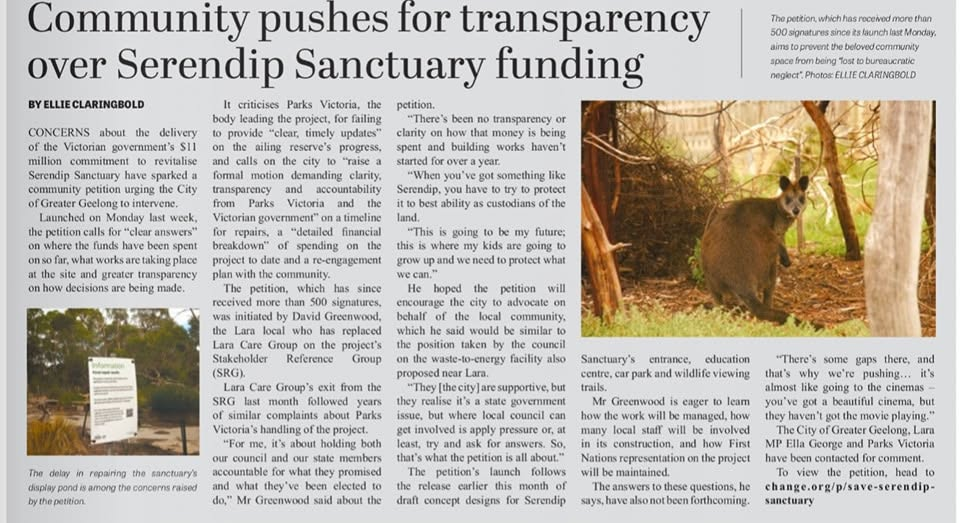
If you've followed local coverage, you'll know Serendip has been the subject of sustained community advocacy. It's worth understanding before you visit, because it shapes what you'll see on site.
The Victorian Government committed a significant sum — in the order of $11 million — to a redevelopment of the sanctuary. More than a thousand residents have since signed a petition asking for one thing: a clear, public account of how that money is being spent.
To be plain about it, because this gets misrepresented: the campaign is not opposition to investing in Serendip. Nobody local is arguing against improving the place. The request is for transparency about a redevelopment of a much-loved public reserve, and for confidence that the works enhance rather than diminish it.
I represented those residents in submitting a formal motion and set of questions to the City of Greater Geelong. Mayor Kontelj wrote to the Minister for Environment raising the community's concerns. Council had formally requested a meeting with the Minister as far back as March 2024; repeated follow-ups did not result in one. The full account of that process — including the night our motion was omitted from the minutes due to a Council administrative error — is in a separate article.
Serendip is managed by the State Government through Parks Victoria, not by council, which is why so much of this has involved advocacy rather than direct decision-making.
In preparing this guide, we sought comment from Ella George MP, Member for Lara, and from Parks Victoria — on the current status of the works, the completion timeline, and the accounting for the redevelopment funding.
Neither has responded at the time of publication. If either provides a response, this article will be updated to include it in full. The invitation remains open, and I'd genuinely welcome it.
03 / What you'll actually seeSet your expectations well.
The honest framing is this: Serendip is a conservation reserve with an education role, not an attraction built around guaranteed sightings. Some species are close to certain. Others depend entirely on luck, season and how quietly you move.
Realistic expectations
What you're likely to see, and what's a genuine treat.
Near certain — kangaroos and emus
Eastern grey kangaroos are a reliable presence across the open grassland, particularly early and late in the day. Emus are commonly encountered on the walking circuits.
Very likely — waterbirds on the wetlands
Ducks, ibis, swamphens, spoonbills, herons and cormorants use the wetland system. Numbers rise and fall with water levels, so a wet winter reads very differently to a dry February.
The reason people come — brolgas
Serendip has a long association with brolga conservation. Seeing one properly — tall, grey, deliberate — is the moment most visitors remember. It is not guaranteed on any given visit, and that's rather the point.
The rare one — Australian bustard
A bird most Victorians will never encounter in the wild. Serendip's role in bustard breeding programs is a genuine piece of conservation history worth knowing before you arrive.
Species presence varies with season, water levels, breeding cycles and management works. Treat every list as a possibility, not a promise.
04 / Choosing your walkMatch the trail to your group.
The most common mistake is picking the longest loop because it sounds the most impressive, then rushing it with a four-year-old who needed the short one. Serendip has options; use them.
Pick before you park
Four different visits, same reserve.
With small children
Stay near the wetland viewing areas and the shorter loops close to the entrance. Bring a drink and plan to stop often. The birds do the work; you don't need distance.
Serious about birds
Arrive at opening. Walk the wetland circuits slowly, sit at hides and viewing points, and give each one ten unhurried minutes. Binoculars change this visit completely.
Wanting a decent walk
Take the longer grassland and woodland circuits for a proper hour or more on foot across open volcanic plains country.
Accessibility needs
Some paths and viewing areas are considerably more manageable than others. Check current track conditions with Parks Victoria first — surfaces vary, and this landscape gets boggy after rain.
Trail configurations and access can change with works and seasonal conditions. Confirm current arrangements before committing a group to a route.
05 / TimingThe single biggest factor.
If you take one thing from this guide, take this: when you visit matters more than anything else you decide.
Time of day
Same place, completely different experience.
Early morning — do this
Cool air, active birds, grazing kangaroos, still water for reflections, and very few other people. Wildlife is genuinely more visible, and the light is better for photographs.
Middle of a hot day — avoid
Animals shelter and go quiet, heat sits heavily on open grassland with limited shade, and you'll walk the same paths seeing a fraction as much.
Late afternoon runs a close second to early morning. The hours in between are the least rewarding time to be there.
Season matters too. After good rain, the wetlands fill and waterbird numbers climb. Spring brings breeding activity and wildflowers on the plains. High summer is hot, dry and exposed — still worth it early, genuinely unpleasant at midday.
06 / What to bringA short, honest list.
Pack this
Six things that make the difference.
Binoculars
The upgrade that transforms the visit. Even a cheap pair turns a distant grey shape into a brolga.
Water — more than you think
Open grassland, limited shade, and a walk that takes longer than expected once you start stopping to look.
Hat and sunscreen
Non-negotiable on the plains from October to March.
Proper shoes
Unsealed sections and post-rain mud. Not the visit for good sneakers.
Patience, deliberately
Budget time to sit still. The best sightings arrive when you stop generating noise and movement.
Everything out with you
Whatever comes in goes home with you, including food scraps.
07 / The rules that matterWhy they exist.
Every rule at a place like Serendip traces back to something that went wrong somewhere. Worth knowing the reasoning, not just the sign.
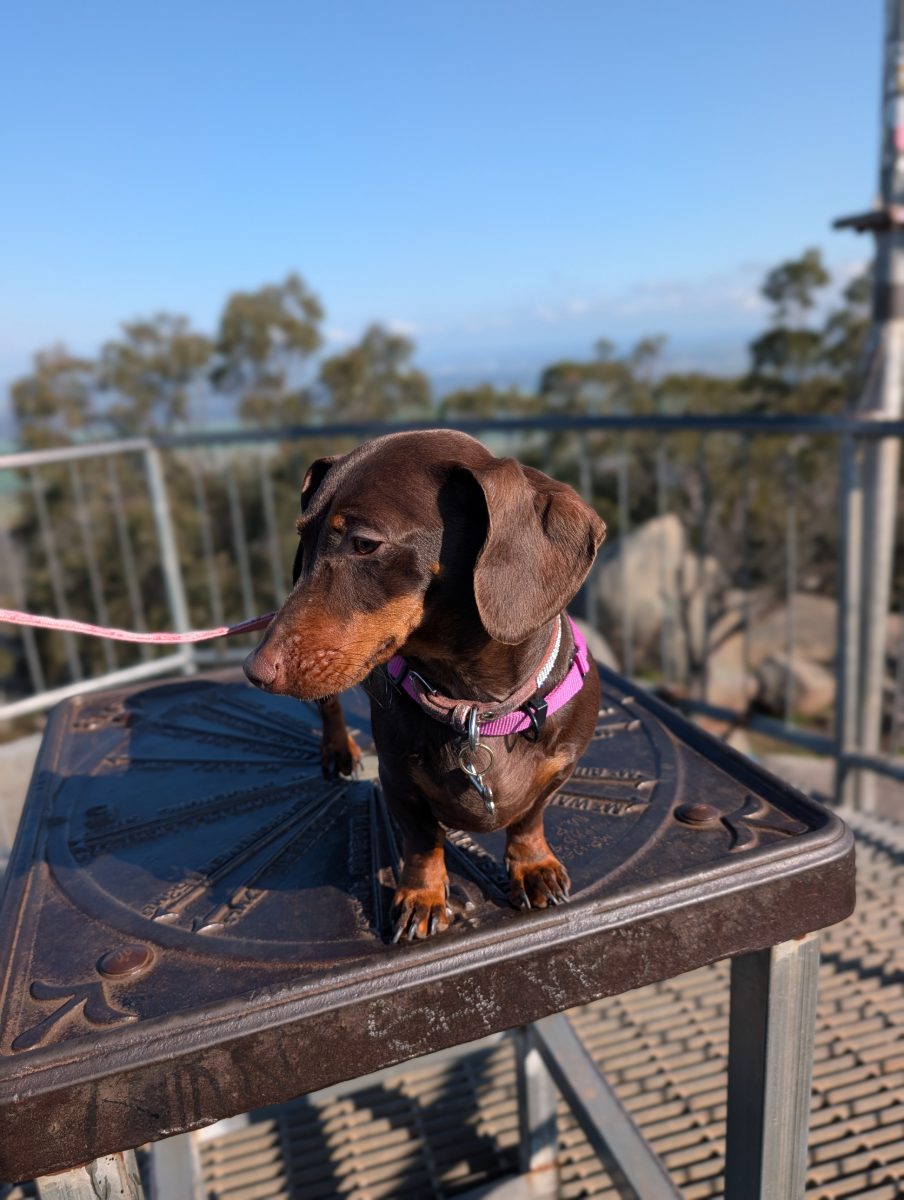
No dogs. This is the one that catches people out, and it is the most important. Ground-nesting and wading birds abandon nests when a dog passes — even a well-behaved one on a lead, even one that never gets close. The scent alone is enough. If you want a walk with your dog nearby, the You Yangs and other reserves have designated areas; Serendip cannot be one of them.
Don't feed anything. Human food damages wildlife health, makes animals dependent and bold, and concentrates them unnaturally in ways that spread disease.
Stay on tracks. The grassland here is a threatened vegetation community, not just paddock. Off-track walking compacts soil, spreads weed seed and disturbs nesting.
Keep your distance. If an animal changes what it's doing because of you, you're too close. Kangaroos and emus in particular deserve real respect at close range.
08 / Making a day of itWhat else is nearby.
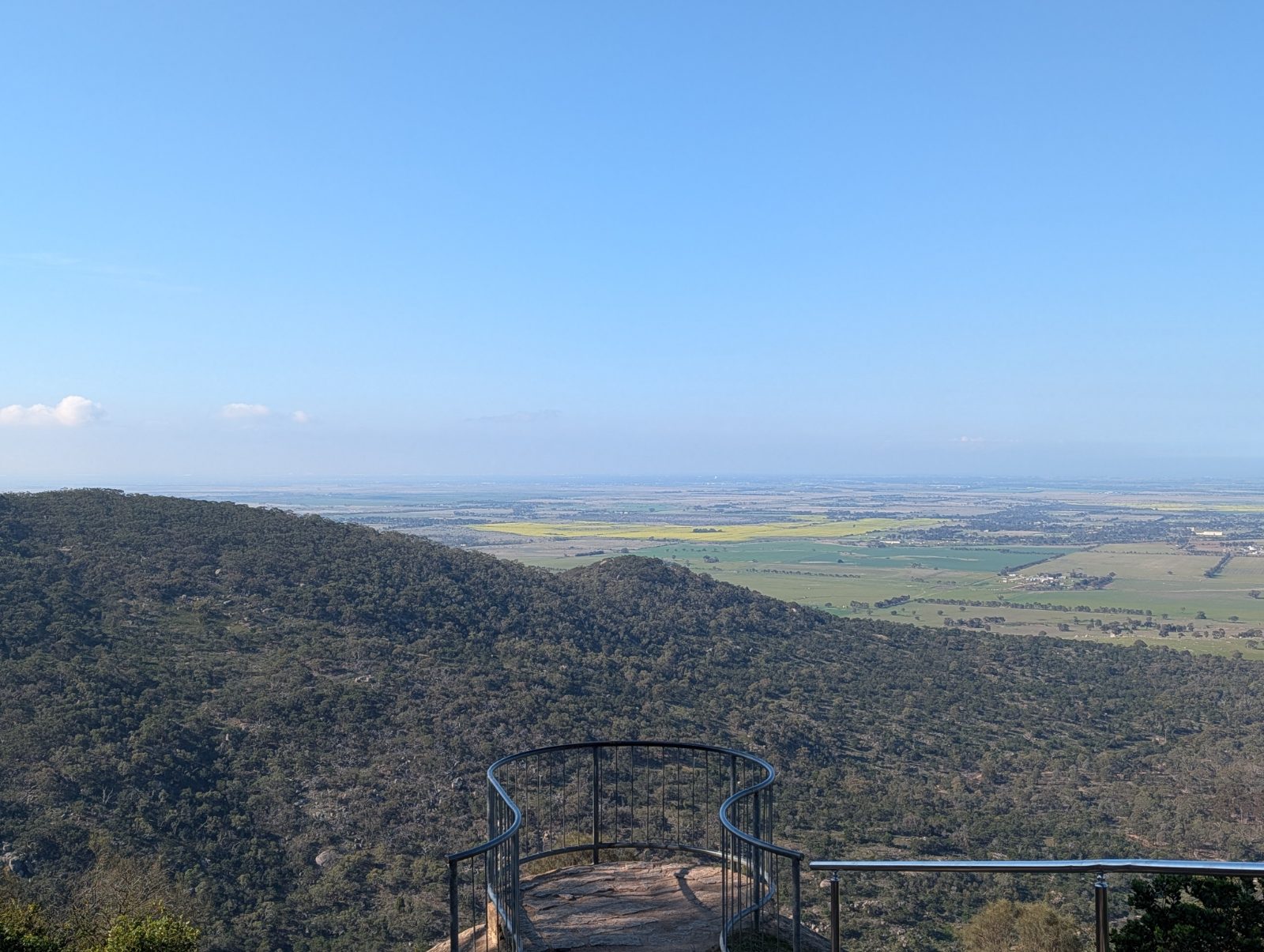
Serendip pairs naturally with the rest of this corner of the ward. The You Yangs are close by for a summit walk and a view back across the plains you've just been standing on. Lara township has coffee and a bakery. It's an easy morning-at-Serendip, lunch-in-Lara, afternoon-in-the-You-Yangs sort of day — and it shows off a part of Greater Geelong that visitors routinely drive straight past on the highway.
09 / The works, on the groundWhat's actually been built.
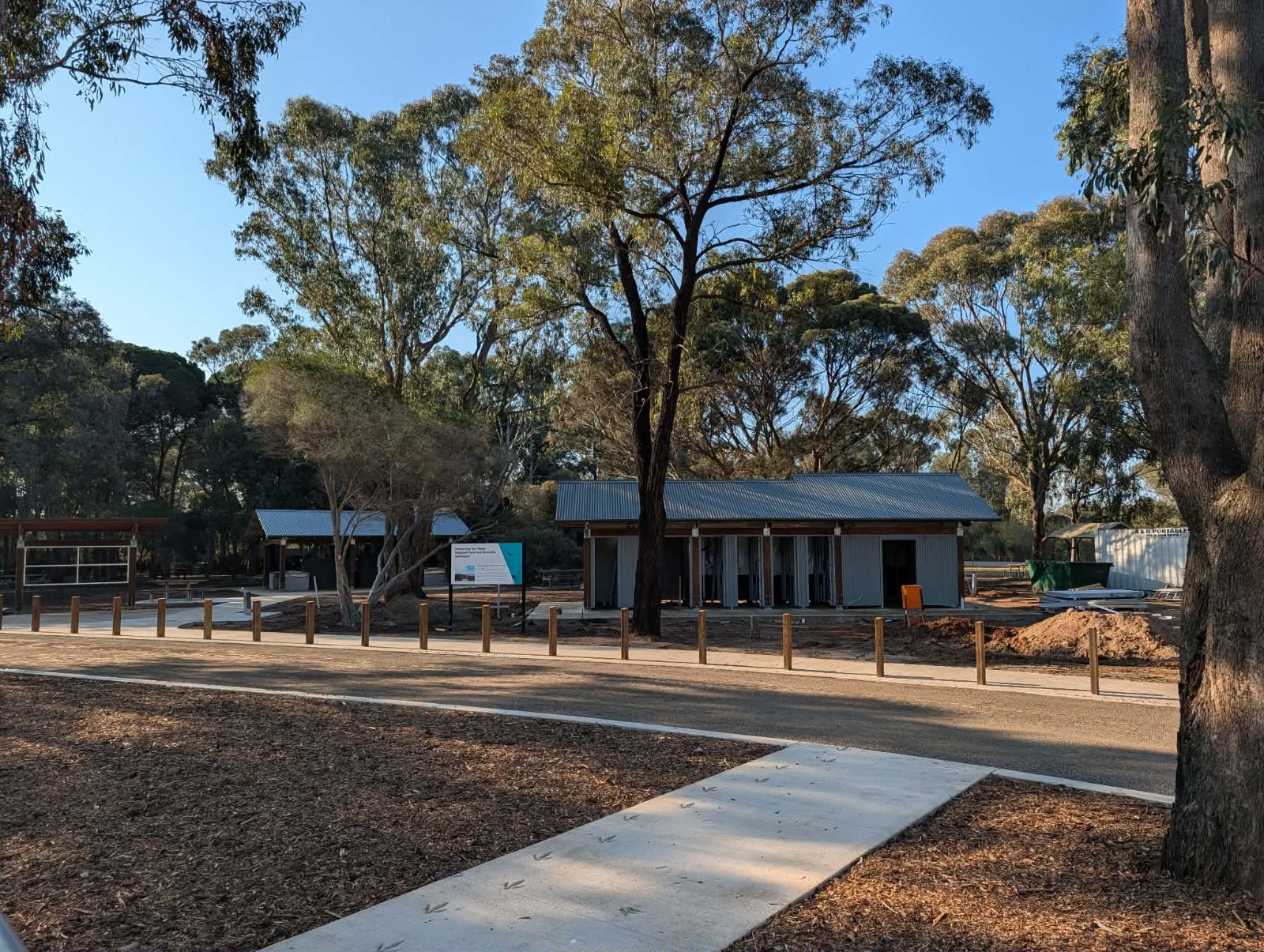
There has been a lot of discussion about the Serendip redevelopment, much of it conducted at a distance. So here is what it looks like in person. I took these on site in August 2026.
The new visitor building is up and clad, with the shelters and picnic areas beside it complete. The car park has been resurfaced and line-marked, with bollards, mulched garden beds and new interpretive signage in place. Concrete paths now run from the car park through to the facilities.
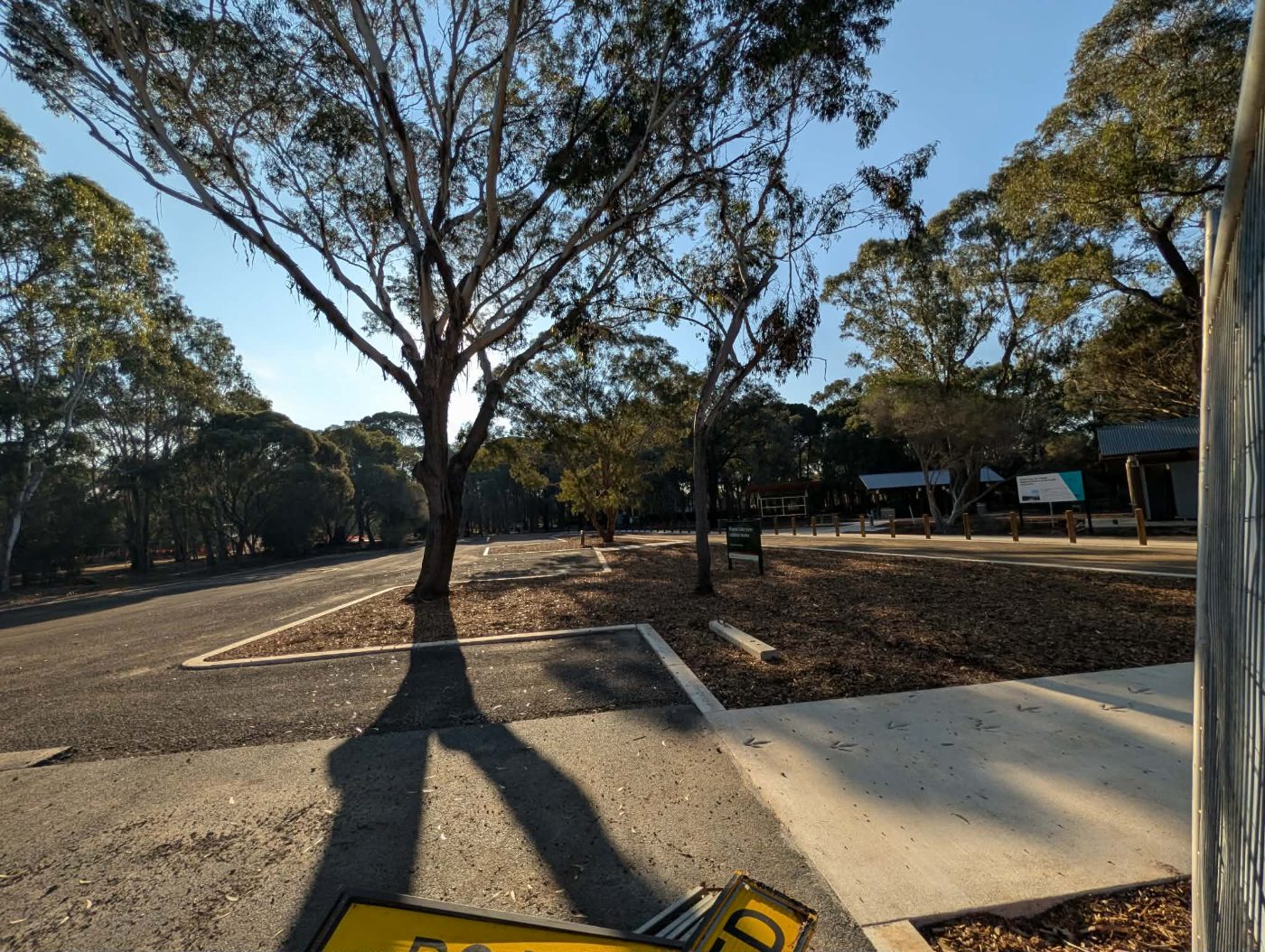
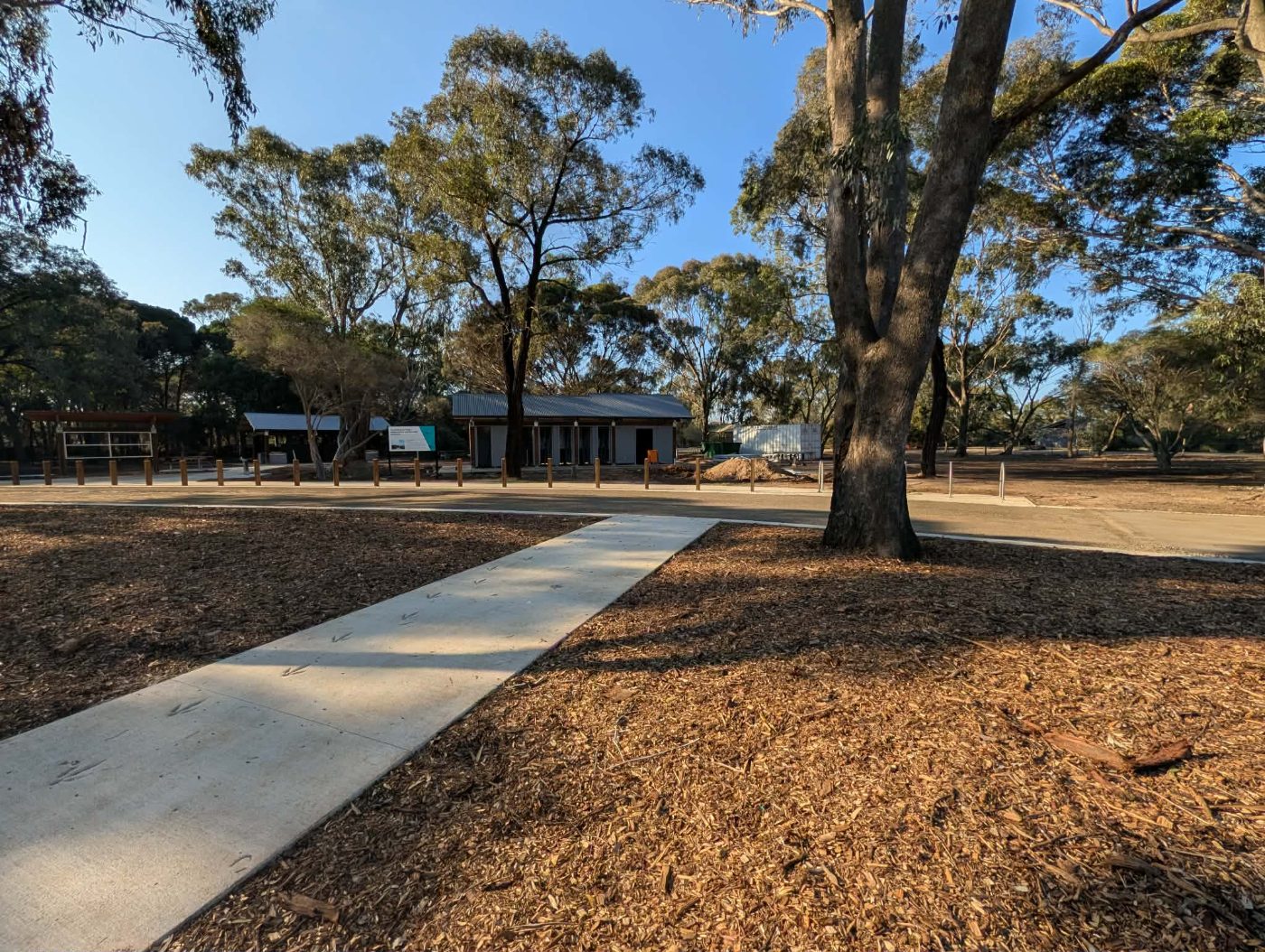
And then there's the detail I genuinely didn't expect, and the reason I'm including these photos at all.
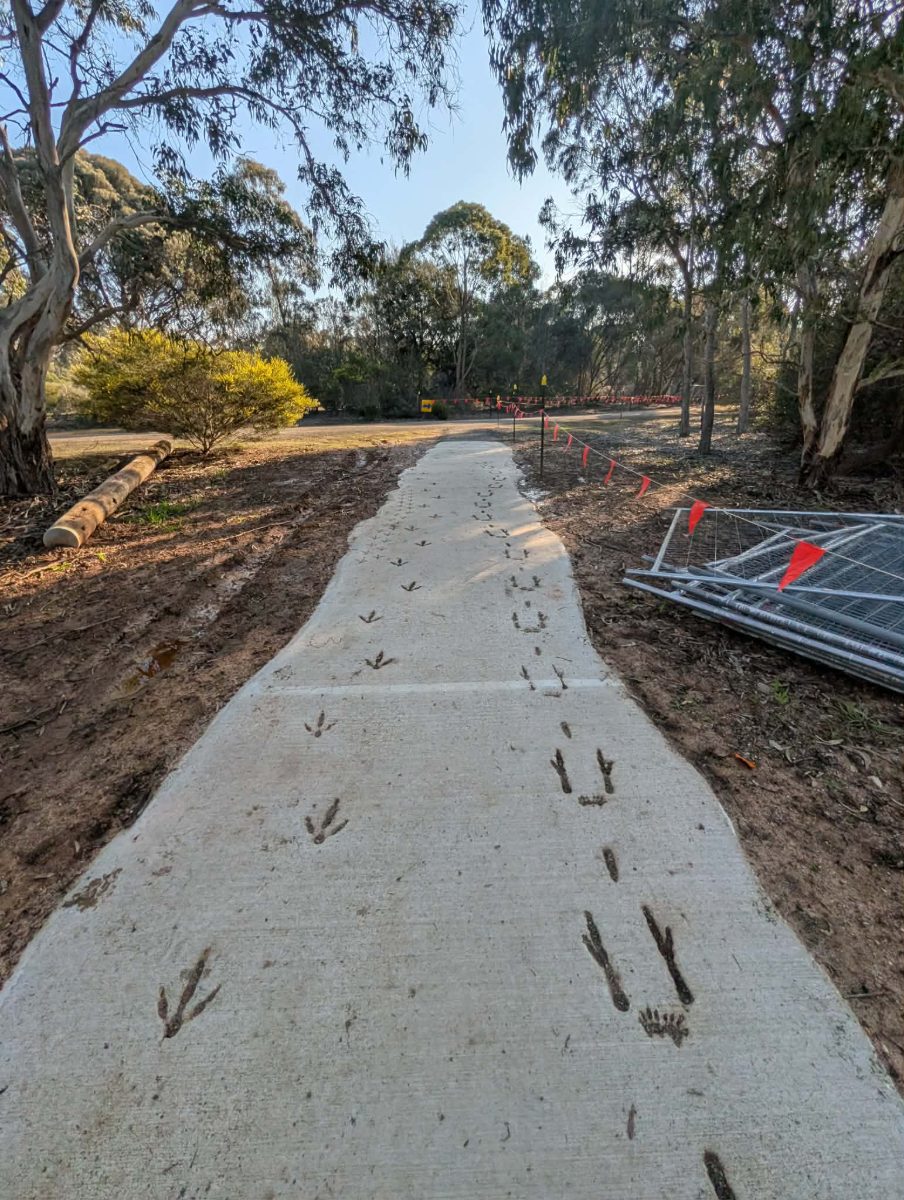
The residents got there before the contractors did. Emus and kangaroos walked the paths while the concrete was still curing, and their tracks are now set into the surface for good — along with what looks very much like a possum print near the edge.
I can't think of a better argument for why this place matters, or a better reminder of who the site actually belongs to. Nobody designed that. It's just what happens when you build something in the middle of a working sanctuary.
Worth looking down for when you visit.
What I still can't tell you, because nobody will say, is the completion date, the final scope, or how the $11 million has been allocated across these works. Those are the questions we put to Ella George MP and to Parks Victoria. Both remain unanswered. The photographs above are, at present, the most detailed public account of progress that exists — which rather makes the point about transparency.
10 / Why it's worth caring aboutA local view.
I've written separately about the transparency questions around Serendip's redevelopment funding, and I'd encourage you to read that too. But the two things sit together rather than in tension.
The reason more than a thousand residents signed a petition about this place is not that they're opposed to investment in it. It's that they love it, they've taken their children there, and they want to know that money committed to it is being spent well and in the open.
You look after the things you actually visit. The strongest protection any reserve has is a community that knows it well enough to notice when something changes.
So the most useful thing I can suggest is genuinely the simplest one: go. Take the kids, take the binoculars, go early, and give yourself two hours rather than forty minutes. Places like this survive on the strength of the local relationship with them.